Teacher
PHYSICS 390: PHYSICAL AND MATHEMATICAL FOUNDATIONS OF QUANTUM MECHANICS
Fall 2008
Teacher: Alfred Scharff Goldhaber
Yang Institute (Math 6-113, 2-7975, goldhab@insti.physics.sunysb.edu)
Office Hours: By appointment or drop in
Class meetings: TuTh 6:50-8:10 PM
Texts: New course -- hence no textbook
No Written Exams
Motivation
In more than eight decades the teaching of quantum mechanics has been
stuck in a pair of patterns which might have been OK when they were
fresh and new, but now seem tired and inadequate. The first approach
is historical. There is some logic to that, because if people
originally found things in a certain sequence then it is at least
possible for students to learn in that sequence. This is the style
especially of "modern physics" courses, where "modern" means (at
least for a large part of the material) verging on 100 years old! The
other method is axiomatic, exemplified by Dirac's great book on the
subject. If the former is warm and fuzzy (in the sense of including
many interesting bits and pieces, but without an overarching coherent
structure), the latter tends to appear as cold and unmotivated. My
method could be called "quasi-historical," meaning to build on a
history that might have been if Einstein in 1905 had shown even
greater audacity than he did in his "photoelectric effect" paper. The
path, as indicated in the outline below, goes through Maxwell
electrodynamics to one-photon quantum mechanics, and uses that as a
base to develop one-electron quantum mechanics. I call this way
"stronger, deeper, better" [Stronger: there is an organic connection
to electrodynamics, which leads through Einstein's light quanta to
photon quantum mechanics. Deeper: The two essential notions of
quantized energy and photon intensity give a base for everything
else. Better: These two notions allow deduction in a natural and
straightforward way of most if not all the remarkable and puzzling
features of quantum physics, without the abrupt transitions of a
modern physics course or the cold start of a standard formal
course.] I believe this approach could help overcome what seems to
me a deficiency in current physics training, that students are
exposed to classical mechanics and classical electrodynamics twice
during their undergraduate years, but quantum physics just comes
along at the end. Eventually, this might be a first-term sophomore
course, and strongly motivated students at that level would be
welcome already now.
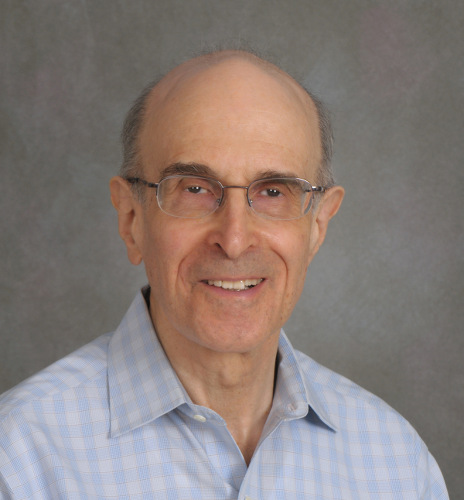
Teacher
Alfred Scharff Goldhaber
Ph.D., 1964, Princeton University
Fred Goldhaber represents the second of three physics generations in
his family. Collaboration with his parents led to what may have been
the first mother-son publications in physics. Among his research
publications are articles on magnetic monopoles, elementary
particles, nuclei, condensed matter, and, recently, cosmology. Themes
that help to bind these topics together include the principle of
gauge invariance, the use of classical limits and the correspondence
principle, and the study of long-distance, low-energy constraints on
objects that may have quite high-energy internal structure. He is
co-author of three review articles, "Terrestrial and Extraterrestrial
Limits on the Photon Mass," "Hypothetical Particles" (with Jack
Smith), and "High-Energy Collisions of Nuclei," as well as an
annotated bibliography, Magnetic Monopoles. He enjoys hindsight
heuristics, asking why people made discoveries later than they might
have; understanding this better could aid future discoveries.
Audience
This new course should be appropriate for students preparing for the
standard quantum physics sequence, for students currently enrolled in
advanced quantum physics (which I also shall be teaching this fall
Tu-Th 520-640 PM), and for students interested in learning the
principles of quantum physics who have a strong preparation in
first-year classical physics and first-year calculus, whether they
are physics majors or not. Thus the prerequisites for the course are
two semesters of introductory physics (PHY121-2,131-2, or 141-2 or
equivalent) and two semesters of introductory calculus (MAT 125-6 or
equivalent). The plan is to keep the course self-contained with
respect to more advanced topics, e.g., matrices and linear operators
more generally.
Course Outline
Requirements and grading
This course will depend on regular and active class participation by all students. There will be weekly written homework, and the other component of the grade will be based on regular class presentations by students, sometimes of solutions to homework problems and sometimes of important topics that go beyond the lectures. I expect to comment in detail on the student presentations, to make sure that people know what I expect and that any obscure points are clarified. There will be no written exams.