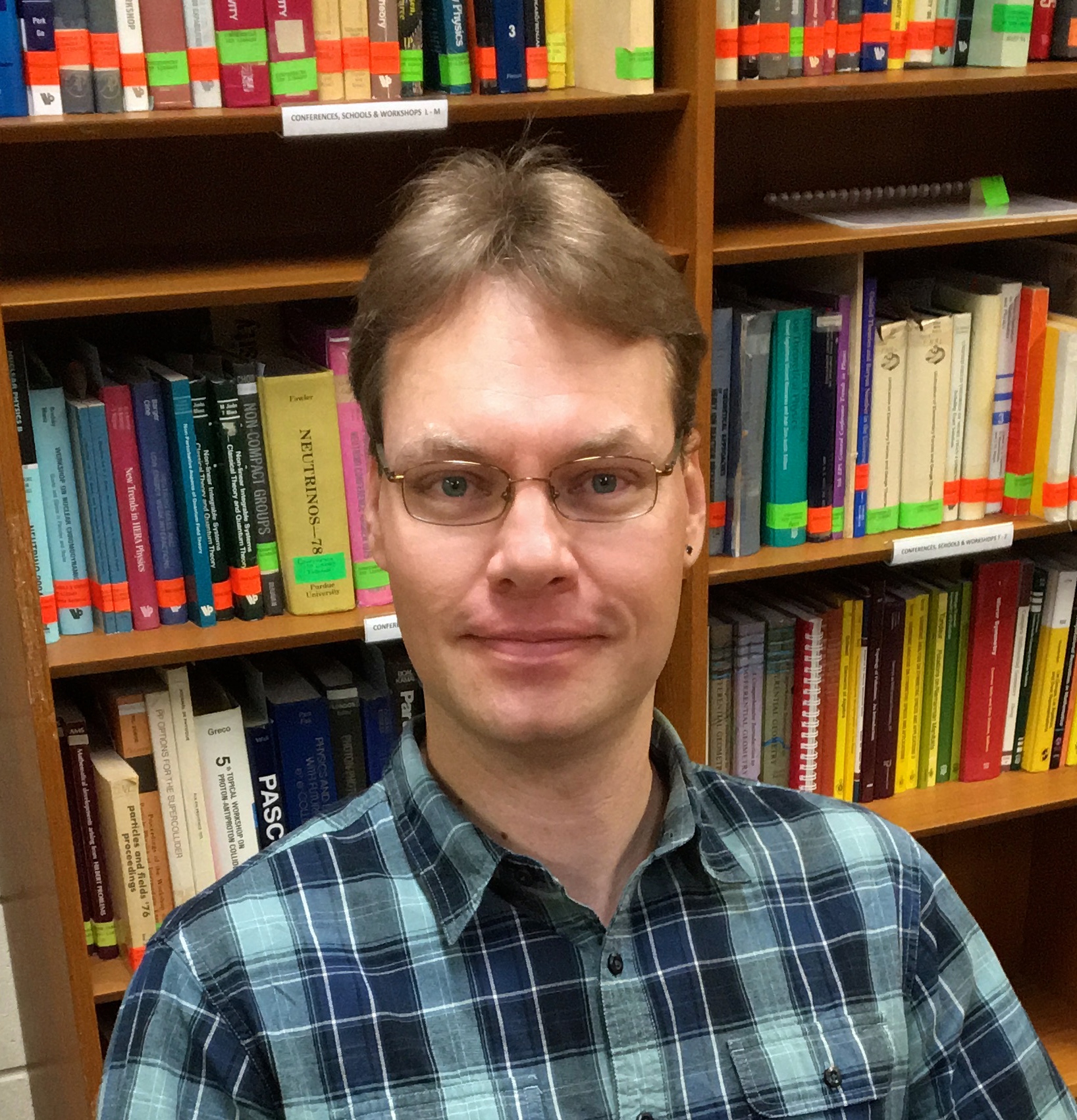
About Me
I am a Professor of Physics and Astronomy at the C.N. Yang Institute for Theoretical Physics (YITP) at Stony Brook University in Stony Brook, New York, USA.
I am a theoretical particle physicist whose research focuses on the search for dark matter and other new particles beyond the Standard Model of particle physics. My work spans several areas of physics, including particle and astroparticle physics, cosmology, and condensed matter physics. I study the fundamental building blocks of matter (particles) and their interactions (forces), and how they shape our Universe.
I have helped pioneer several novel detection concepts to probe both dark matter and new force carriers below the proton mass, and have been a leader in establishing these as new research directions, which have attracted significant theoretical and experimental efforts worldwide. I have also studied the impact of annihilating, decaying, self-interacting, and dissipative dark matter on a wide range of scales, using astrophysical and cosmological observations to probe its properties.
I was born and grew up in South Africa. I received my undergraduate education at the University of the Witwatersrand in Johannesburg, earning B.Sc. (Hons.) degrees in both Physics (2001) and Mathematics (2002). I completed my Ph.D. in Physics from Rutgers University in 2008. Before joining Stony Brook University in 2011, I was a Research Associate at SLAC National Accelerator Laboratory at Stanford University from 2008 to 2011.
I am a Fellow of the American Physical Society (2020). My awards include the New Horizons in Physics Prize (2021), a Simons Investigator Award (2019, renewed 2024), the American Physical Society's Henry Primakoff Award for Early-Career Particle Physics (2015), a Sloan Fellowship (2013), and the DOE Early Career Award (2012). I am one of ten principal investigators of the Targeted Simons Research Group on Dark Matter Dynamics (2027–2029).
Research
My research focuses on searching for dark matter and other new particles beyond the Standard Model of particle physics, using theoretical and experimental tools that span various frontiers: theory, cosmic, energy, and intensity.
Dark matter comprises approximately 85% of the matter in our universe, yet its identity remains one of the greatest mysteries in physics. Even its most basic properties—such as how much it weighs and how it interacts with known matter—remain unknown. My work involves conceiving new ideas for what constitutes dark matter and developing new ideas for detecting dark matter particles and any unknown forces using laboratory, cosmological, and astrophysical data.
I collaborate with a wide range of scientists, including particle and astroparticle theorists and experimentalists, astronomers, condensed matter theorists, AMO physicists, quantum information scientists, instrumentalists, theoretical cosmologists, and N-body dark matter simulators. Current directions include calculating how dark matter interacts with electrons in materials, understanding the backgrounds that limit the most sensitive detectors, and using space telescopes as dark matter detectors. On larger scales, my group models dark matter with its own forces, including dissipative dark sectors, and predicts what it would do to subhalos, gravitational lenses, and stellar streams, and what exotic compact objects it might form.
Research Areas
Research Papers
An up-to-date publication list can be found on iNSPIRE or ADS.
Research Group
Prospective PhD/MA students: Information about the Stony Brook Physics and Astronomy PhD program and how to apply can be found here. If you are already a student in the program and would like to learn more about my research and available positions, please contact me.
Postdoctoral Mentorship: In addition to advising and mentoring students, I have worked with and/or helped mentor numerous postdocs at the Yang Institute for Theoretical Physics who currently hold faculty positions. These include Kim Berghaus, David Curtin, Peizhi Du, Oren Slone, Kohsaku Tobioka, Mauro Valli, and Tien-Tien Yu.
Awards & Honors
Experimental Collaborations
Although a theorist, I am participating, or have participated, as a co-spokesperson and/or member in several experiments that were motivated at least in part by my theoretical research. These experiments focus on direct searches for dark matter and new forces:
SENSEI (Co-Spokesperson) — Sub-Electron Noise Skipper CCD Experimental Instrument, a dark matter direct-detection experiment with unprecedented sensitivity to sub-GeV dark matter particles.
APEX (Co-Spokesperson) — The A' Experiment at Jefferson Lab, searching for dark photons in the mass range from 65 MeV to 550 MeV.
Oscura, DarkNESS, HPS (Collaboration Member) — Additional experimental efforts searching for sub-GeV dark matter and new forces.
Contact
Stony Brook University
Stony Brook, NY 11794-3840, USA